Racialising disease: new syphilis resource in Victoria

Photos have surfaced of a new syphilis resource in Victoria and it is ~problematique.~

Update: activist and TIM co-founder Nic Holas followed up with MSHC and they advised the resource was produced in 2013 and ‘pulled’ after complaints.  Copies of the resource pictured below were picked up this morning, so it seems they are still distributing it.

Syphilis resource from Victoria via Bryan Andy pers comm 12 July 2016
Hat tip and thanks to Bryan Andy for posting this and sharing his critique.

Let me describe the image: there is a phone displaying what looks like a dating app with tiled face pictures. Five of the tiles display smiling Anglo, Latino or Mediterranean faces. All of the remaining tiles are taken up by a photo of a Black or Asian man, tinted deep red, with the username ‘SYPHILIS’.

Beside the phone is a speech bubble saying ‘OMG he’s everywhere! SYPHILIS.’ Below it there’s some text providing facts about syphilis transmission and a fine print warning ‘Brochure contains explicit photographs of male genitalia’.

I have so many questions. Who produced this?  Was there a reference group? Which community organisations were consulted? Was it focus tested?

The explicit photos of STI infection make me think that it’s probably from the Melbourne Sexual Health Centre, because they love that shit.  If you’re doing their electronic admission questionnaire and you say you’re not sure if you have symptoms, they will show you page after page of diseased genitalia.  I took a friend there for his first ever HIV test and he nearly walked out of the clinic in horror.

The other give-away is the creative concept is so hackneyed: iPhones and app screens and ‘OMG’ are so last decade.  It reads like a Boomer attempting to be ‘hip ‘n’ happenin’.

I asked about a reference group and focus testing because these are both opportunities to challenge groupthink.  You might have a clinician who’s also a gay man, but a community educator has a much better understanding of how other gay men are different from him. 

Similarly, when we focus test, we’re inviting a discussion among a sample of participants as diverse as we’re able to recruit, in order to get a sense of the range of different possible interpretations of the stimulus material.

But this wouldn’t have made it to focus testing on any reference group I was part of.

It’s always good to invite a marketer or designer or photographer or illustrator or cultural studies researcher onto your reference group.  That’s because we understand that images have plural connotations.  They don’t always signify in the way we might intend them to.

We draw on a mental library of these connotations — a symbolic history of the culture that informs how audience members might interpret the images and therefore the message.

Accordingly, I ‘read’ the images above and their accidental references in these ways:

  • If audience members view the man pictured as Asian and we’ve overlaid his face with a red tint, the unconscious associations that might be triggered include the visual imagery used in propaganda stoking WWII fears of Asian invasion of Australia.
  • If the man pictured is viewed as black, then we’ve got an accidental reference to Tuskegee, where clinicians left African American men with syphilis untreated for decades in order to study the natural progression of the illness. We’re also then referring to racial stereotypes of black men as hypersexual spreaders of disease, as seen in the moral panic about bisexual black men ‘on the down low’ last decade.

As an American colleague recently explained to me, American social science maintains a distinction between two competing systems of differentiation: race and ethnicity.  I mention America because I’m pretty confident this image was constructed using stock photography or a photo-composite taken from America.

In the image, the uninfected people are shown as Anglo or light-skinned ‘ethnic’ while the guy who poses a threat to them — and by extension the audience member — is depicted as ‘racially other’.

Racist discourse often draws analogies between immigration and plague, subjugated and racialised others as pestilence, and this imagery unwittingly reproduces that analogy.

I understand stigma, with Parker & Aggleton (2003), as the production of difference in the service of power — in ways that normalise unjust social orderings.

The pictured resource exemplifies this.  It visualises an association between disease, contagion and non-white race. In other words, it marks out non-white people as differing from white people by having increased prevalence of disease.

It would have been trivially easy to use the highlight colour to symbolise the disease and overlay it on multiple, racially diverse faces.  In other words, either the problem was not spotted or a choice was made to ignore it.  (See update at the top of this post.)

The end of AIDS?

My supervisor messaged me: “ABC news right now – the end of AIDS as a public health issue.”  Fairfax was reporting it too:

AIDS epidemic ‘over’ in Australia, say peak bodies

Australia’s peak AIDS organisations and scientists have announced an end to the AIDS epidemic, as the country joins the few nations in the world to have beaten the syndrome.

The number of annual cases of AIDS diagnoses is now so small, top researchers and the Australian Federation of AIDS Organisations [AFAO] have declared the public health issue to be over.  (Saimi Jeong, The Age 10 July 2016)

In blog posts and feature articles for some time now, I’ve been arguing that media framings, policy-making and popular understandings of HIV have lagged behind reality, holding onto notions of the ‘AIDS crisis’ and HIV as a deadly disease.

These ‘zombie notions’ impede sensible policy-making around prevention, such as the removal of outdated HIV-specific laws, and public funding for pre-exposure prophylaxis — medication that protects HIV-negative people from infection during condomless sex.

lazarus

Gary Dowsett first conceptualised ‘post-AIDS’ thinking among gay men in 1996.  In 2004, at a plenary session of the HHARD and HIV Educators’ conferences, I described myself as ‘pre-AIDS’ — born in 1981, coming out to myself in the mid-90s, the ‘AIDS crisis’ was over in the gay community before I ever joined it, and I’d had to reconstruct an understanding of what it had meant for the people around me.  More recently, cultural studies scholar and critic Dion Kagan wrote his PhD on ‘post-crisis’ meaning-making around HIV, along with a stellar series of columns exploring this theme in The Lifted Brow.

I understand the messaging from AFAO and celebrity scientist Prof Sharon Lewin in this context.  At first I wondered what it was about.  I think there are three things going on:

  • The number of people dying from AIDS, rather than dying with HIV, is now so low it violates statistical conventions against reporting cell sizes under 5.
  • AFAO might have wanted to shift the media and policy narrative and ‘claim a win’ to count against what’s starting to look like the inevitable failure of ‘Ending HIV‘.
  • Australia wanted an ‘announceable’ going into the AIDS2016 conference in Durban.

(Update: AFAO’s CEO Darryl O’Donnell did a great job challenging outdated narratives on ABC Radio National Breakfast this morning — you can listen to the interview here.)

A number of people have expressed concern to me that this announcement obscures the reality of ongoing, smaller AIDS crises in particular groups, including migrants and refugees, especially those who lack access to Medicare, and Aboriginal communities.

Since 1996 we no longer focus on deaths from AIDS nor even AIDS diagnoses — early diagnosis and treatment are the ballgame. People with late diagnosis, defined as a t-cell count below 350 per millilitre of blood, have elevated lifetime risk of serious illness, including cardiovascular events like heart attack, even after they start on treatment.

Update:  The figure below shows the heterosexual communities in which late diagnosis is common. Spoiler alert — it’s all of them.  And the personal impact of infection will be far greater for people are living in communities where outdated notions of HIV still predominate; where strategies to tackle stigma and discrimination are nascent or non-existent; and that in many cases haven’t yet developed cultures of care to support treatment and wellbeing.

Screenshot 2016-07-11 08.05.47
Source: Kirby Institute, Annual Surveillance Report 2015 p51 (pdf)

In other health issues, such as cancer screening, the identification of lower rates of screening in specific communities compared to the Victorian population average has been used to target them for additional funding and recruitment initiatives.  But the danger is always that small clusters get swept under the carpet, protected from identifiability by that convention against reporting cell sizes under 5.

My concern about this messaging is that it depends on policy-makers understanding that AIDS is not a journalistic synonym for HIV.

If they don’t, this message will look like a green light to ‘mainstream HIV’ — ditching peer based services and funding hospitals, nurses, social workers and MPH grads to ‘mop up’.  That would be more expensive than community-based services, but it would restore what the health system views as the natural way of doing things — top down, expert-led.

Bernard Gardiner, a PhD scholar working on a qualitative longitudinal study of aging, place and social isolation among people living with HIV in Queensland, and a respected elder of the Victorian gay community response to AIDS, puts it this way:

I think this is careless. This takes the pressure off Public Health officers working for Government, who see psycho-social support services for long-term survivors as unnecessary ‘hand-holding’ that Gov should not fund. It also disguises the reality that some long-term survivors struggle for quality of life with depression, multiple co-morbidities, cognitive issues, cancers/heart/renal issues, and poverty, and feel somewhat abandoned by the biomedical 90/90/90 focus.

Once upon a time a shift like this would have been thoroughly debated among the AFAO membership and communicated to affected communities via community media.  This would have provided an opportunity to prepare for the secondary messaging that will be necessary to make sure this message doesn’t backfire.  We live in interesting times.

Digital quarantine? Grindr considers HIV filter

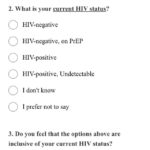
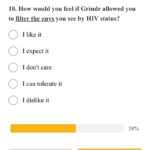
A colleague from UMontréal, David Myles, posted these Grindr screencaps in a group for researchers interested in hook-up apps.  Turns out Grindr is surveying at least some of its members to find out how they feel about filtering other members by HIV status.

For a long time it has been possible on sites like BarebackRT and Manhunt to search by HIV status — for example, to facilitate serosorting as a way of partially reducing the risk of HIV transmission during unprotected sex, before PrEP came along.  Users could also save searches, so if they ticked every box except HIV-positive, they could construct their own de facto anti-HIV filters.

But it is a completely different ballgame for the makers of an app to build in a feature that effectively facilitates digital quarantine of people living with HIV.

It signals that HIV stigma is normal and rational.

Now, it could be said that people who use the filter are effectively isolating themselves from people living with HIV — reducing the likelihood of encounters where stigma is enacted in the form of verbal abuse and discrimination.  (Here’s one I prepared earlier.)

But Grindr filters, to the best of my knowledge, only stop matching profiles from appearing on the ‘grid’ — the display cabinet or catalogue of other users.

Would the HIV filter work differently, making that user invisible to others whose HIV status didn’t match their preferences — more like an automatic block function?

If it did, and enough HIV-negative people used it, it really would constitute a form of digital quarantine that leaves people with HIV outcast and invisible.

If it didn’t, it might set the scene for even more stigmatising encounters, fuelled by filter users’ surprise (and probably anger) that someone with HIV had contacted them.

Alternatively, they might assume that everyone who contacted them was HIV-negative, and the problematic implications of that assumption are well-known.

Grindr needs to cut this out.  Right now.  We are living in an era of effective prevention medication.  We should not be reinforcing categories that are used in less effective strategies for prevention.

‘Ending AIDS in a generation’

I’ve been openly critical of the rhetoric in global HIV/AIDS policy around ‘ending HIV’.  For instance, at the MSM Global Forum pre-conference in Melbourne before AIDS2014, when US global AIDS ambassador Debbie Birx exhorted queer and trans people to ‘run a little harder’ towards the goal of ending AIDS in a generation.  This would be a little easier if so many queer and trans people around the world weren’t also running for their lives.

For many AIDS activists, the timing of the Orlando massacre was particularly painful, coming hard on the heels of the UN High Level Meeting on AIDS, where ‘key populations’ of queer and trans people, people who inject drugs and sex workers were actively excluded from deliberations and barely mentioned in the final document.

Laurel Sprague noted one paragraph in particular as a masterpiece of international policy double-speak.  I’ve highlighted the competing voices in different colours:

Reaffirm the sovereign rights of Member States, as enshrined in the Charter of the United Nations, and the need for all countries to implement the commitments and pledges in the present Declaration consistent with national laws, national development priorities and international human rights;

So the ‘run a little bit harder’ rhetoric shifts responsibility away from states and onto communities, making it sound like they’re not working hard enough to end HIV.

There is another problem with the ‘ending HIV’ rhetoric, as seen in this quote from an interview with Bill Gates, one of the largest funders of global HIV prevention:

There’s a few things where you get a slogan like “AIDS-free generation.” … I wish that were more likely. Truthfully, because we don’t have a vaccine, and the prophylactic tools, the compliance of those things has been very poor. We actually run a risk that the next generation will have more AIDS than previous generations.

It’s a story with mostly positive elements, but if you say simplistically we are on the path toward an AIDS-free generation, no, we’re not. We need more R&D, more tools. And if you’re not careful, if you overpromise, you do get this fatigue, and then, even when you still need the resources, people don’t come in.

The experience of the global effort to eradicate polio tells us that even if a preventative vaccine for HIV were discovered tomorrow, it would still take a multi-generation effort to eradicate HIV.  Consistent with Bruce Link and Jo Phelan’s fundamental causes of disease (FCD) model, we’d expect to see rich countries achieve pretty high vaccine coverage early on, and poorer countries (and disadvantaged social groups) taking a lot longer.  The crux of the FCD model is lack of access to what Link and Phelan call flexible resources like money, knowledge, literacy, and social status.

But I want to acknowledge that – at least in Australia – the ‘ending HIV’ rhetoric was in large part an intervention by canny policy entrepreneurs who sensed the winds of change in the early days of the global financial crisis, and knew to anticipate the damage that could be caused by social conservatives having a ‘good crisis’, using austerity discourse to justify huge cuts to social services and welfare.  The extended election campaign we’re having in Australia has created space for unions and social policy researchers and social services peak bodies to tell the story of the billion dollars in cuts under Abbott.

Although the HIV sector is by no means unscathed, with genuinely community-based peaks like Anwernekenhe National HIV Alliance for Aboriginal and Torres Strait Islander peoples getting completely de-funded, and the Australian Federation of AIDS Organisations losing funding for its education program to two of its own member orgs (!), my sense is that things could have been so much worse.

This is a hard one to prove — the counterfactual is a hypothetical what could have been.  But having Australia’s largest state, New South Wales, commit to an Ending HIV strategy, campaign, and program of rapid testing services and early treatment, helped keep HIV prevention on the policy agenda.  So while the science of the ‘ending HIV’ claim is questionable, that was never really the point.

Leaving twitter

This is just a post to confirm I’m shutting my main twitter account @dnmstrategic down on May the 1st.  I follow a bit over 2,000 people, who consistently post thoughtful comments and interesting content, and I’m coming up on 100,000 tweets, both indicators that this is a substantial investment that I don’t walk away from lightly.

If we’ve been in contact on twitter I’d love to stay in touch with you.

I do have a ‘bolthole’ twitter account and I’m planning to add all the accounts I followed to a list on that account — but it’s set on private so I won’t be able to respond to your tweets.

Why take such a step?  A couple of reasons.

One is just that it takes up a lot of time and attention — energy I need to channel into writing articles and PhD work.  Normally I get a lot of value from twitter in return, e.g. interesting conversations, learning about new publications, opportunities and events.

But even with all the privilege I have as an educated able-bodied white middle-class man, twitter’s tendency to pile-ons is a negative externality I’m no longer willing to deal with.

In particular, last month I was the target of a pile-on orchestrated by a guy named Dennis Relojo, a contractor employed by the University of Warwick’s “Piirus” social network for research collaborators.  I asked him to follow twitter conventions for addressing one-to-one tweets, so that my timeline wouldn’t fill up with his attempts to promote the network.  His response was to invite his 10,000 followers to pile on.  They contacted my workplace, signed up my work e-mail up to pornographic mailing lists, dished out homophobic abuse, etc.  And I knew right then: I am done with this.

I also want to acknowledge an incident a while back where the fuckup was mine completely — where I continued the thread of a DM conversation about why I’d blocked a young activist via public tweets.  In the early days of twitter it was more common to do this – to use twitter conversation to discuss other tweeters’ use of twitter to establish (or debate) what the emerging norms were.  But you can’t do that with 2,000 followers; that’s like gossiping into a megaphone.  And twitter had recently changed the block function, so that the person I’d blocked still got notified of my tweets, and they were rightly scathing.

So, in short, I no longer feel secure using twitter.  Its interface and systemic function don’t afford effective ways to deal with pile-ons.  The block function is broken.  Lists are incredibly painful to populate and use.  And speaking as a hot-headed loud-mouth, it is stressful knowing anything stupid I say gets amplified so drastically.  I’d rather use media and formats that invite and afford what Mark Pearson calls, in the Buddhist tradition, ‘right speech‘.

Imagining prevention: the case of violence against women

A few years ago I was working at a research centre and a senior researcher had some money to develop a grant application.  I’d moved there from about ten years in practice in health promotion and I was still figuring out how research practice actually works. So when I was given the brief to do a literature review on what works in addressing racism and preventing violence against women, I didn’t think to ask for a narrower scope.

Alaska_Floodplain_1902
Alaskan flood plain (A.H. Brooks, USGS 1902)

Continue reading “Imagining prevention: the case of violence against women”

Telstra and Catholic bullying

Yesterday brought the news that Telstra has quietly withdrawn its support for the marriage equality campaign, following a threat by the Catholic Archdiocese of Sydney to take their business elsewhere.

2517263767_37197ef014_o
St Mary’s Cathedral Sydney (Sacha Fernandez, Creative Commons License)

My own contract with Telstra is tied up in personal business: my phone is on a discounted friends-and-family plan via my ‘ex-boyfrang’ who worked for them.

It’s in my name and I signed and pay for it, but recently, when I went to get a SIM replacement, the Telstra store told me their records show I don’t have authority ‘on’ (over) the account.

To get it changed, I had to get back in contact with my ex-partner.  I needed him to co-sign a form authorising a ‘change of ownership’.  I’m lucky that my ex is a reasonable guy, but someone leaving an abusive partner who refused to sign would be liable to continue paying for the phone.

So I e-mailed the form… and then nothing happened.  After ten days I followed up by e-mail, then twitter, who asked me to try Telstra’s 24/7 live chat, who (after 30 minutes) asked me to call Billing.

My experience on that call demonstrates why it’s a problem that Telstra caved-in to Catholic bullying on its support for a movement to recognise the equal value of same gender partnerships.

I am not fussed about gay marriage.  My politics are queer, I’m single, when partnered I prefer open relationships, and with David Warner, I view marriage as the top rung of a hierarchy of social status that denigrates single people, sexually adventurous people, and people who do sex work.

On the phone I spoke to a worker in a call centre in the Philippines who could not have been more keen to help me out.  They were incredibly courteous.

But the Philippines is one of the world’s most Catholic countries, and they kept tripping over the fact my ex-partner is male.  They kept calling him ‘she’ and correcting themselves.  They asked if the transfer was from a female friend who is also listed on his account.  That great signifier of heterosexual discomfort, ‘your friend’, got a workout.

Highlighting Telstra’s systemic problems, they reported that the transfer request had been cancelled on their system without any reason being recorded.  When I offered to send the co-signed form to restart the process, they said I’d need to try again with a new form.  When I threatened a complaint to the Ombudsman, they called my ex to get permission.

This is one argument for same gender marriage: it provides access to legislated procedures to manage the division of property and the disentanglement of legal affairs at the end of a relationship.  Without these, gay people depend on institutional employees’ discretion.

Catholic doctrine treats sex and romantic love as things that should only be allowed in the context of a single monogamous lifelong relationship.

That’s why the Church opposes divorce, and why there is such a debate over access to Communion without annulment – a theological procedure that declares the marriage never existed, for the purposes of ‘clearing the slate’.

It’s fine for Catholic people to believe that, but there is no reason why their views should be reflected in the policy of the state — governing people whose lives and views and relationships are different, including non-Catholics, divorced people, and people who love people of the same gender.

The action of the Catholic Archdiocese of Sydney shows that when they can’t, by strength of argument and belief, persuade others to adopt their views, they are willing to throw their weight around, as a sizeable consumer and provider of services, to impose those views on the community.

This is why Catholic providers shouldn’t be running homeless shelters or youth services: under exemptions to anti-discrimination legislation, they are permitted to (and routinely do) exclude same gender attracted, sex and gender diverse people from care.

Those exemptions must be overturned.

And as soon as I ‘own’ the phone account I signed and pay for, I’ll be leaving Telstra.

Regulating HIV transmission

screenshot-2014-10-01-12-16-31-640x358
Source: Beyond Blame Forum: Challenging HIV Criminalisation (July 2014)

Last weekend I flew up to Brisbane for the ‘Risky Business’ forum on HIV criminalisation convened by Queensland Positive People and funded by the HIV Foundation Queensland. It followed on from the ‘Beyond Blame’ pre-conference to AIDS2014 in Melbourne, where I was a rapporteur for the breakout session looking at alternatives to criminal prosecution.

In the still image captured from video taken at Beyond Blame, I’m wearing a look of ‘you’re not going to like what I have to say (but here I am saying it anyway)’.*

That’s because the overwhelming message on HIV criminalisation has been it’s a medical issue that should be managed by public health rather than criminal prosecution.  And my reply was that public health can be just as coercive as criminal law, without the procedural fairness — the ‘right to a fair trial’ — and that this view obscures the way public health and criminal law in fact interact as part of a system for the regulation of HIV transmission.

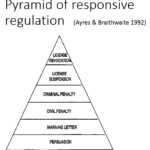
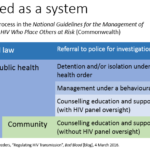
The five stage National Guidelines for managing people who place others at risk of HIV infection demonstrate the articulation of public health management and criminal sanctions as part of a system of responsive regulation (Ayres & Braithwaite, 1992).

Public health and criminal law form two corners of a regulatory triangle around HIV, the third consisting of the cultures of protected sex and safe injecting in communities affected by HIV, as well as the community-based health promotion that shapes these cultures: what I’m calling, after Mitchell Dean, the social governance of HIV transmission (Dean 2010).

In my PhD, I’m using that framing to help think through the imbrication of stigma in the development and audience reception of social marketing campaigns.  At the Brisbane forum I made four concrete recommendations for people thinking about policy reform around this issue:

  1. Improve the procedural fairness of the public health management process.  This is a no-brainer, particularly in Victoria, where the right to a fair trial is part of our Charter of Human Rights and Responsibilities.
  2. Improve the quality of engagement between health departments and communities affected by HIV.  I’m using ‘engagement’ in the sense developed by the W3 project: not ‘consumer representation’ but organisational mental models of the diverse needs, identities and experiences that exist in the community.
  3. Restrict the use of criminal law to cases where it is clear the transmission of HIV has been used to cause harm — not as a regulatory instrument to deter unsafe sex or intervene in sexual cultures of condomless sex.
  4. Strengthen the CBO role in the social governance of HIV transmission.  In particular, this involves raising the awareness of HIV-negative people of their own responsibility to manage risk.

The full analysis and recommendations will appear in a forthcoming article – stay tuned!

Suggested citation

Reeders, D.  “Regulating HIV transmission” in Bad Blood [blog]. 4 March 2016.

* Some would say that’s my usual look.

First day at school

Regnet_640x360
ANU RegNet School of Regulation and Global Governance

In December I got some lovely news: I was accepted into the PhD program at RegNet, the School of Regulation and Global Governance at ANU, with an APA scholarship to study stigma and social marketing — the focus of this blog, now in its tenth year.

choosing a program

I’ve been thinking about this project for a long time, and looking for the right home for it: it’s public health but it’s also sociology and cultural theory, and I’ve watched friends with interdisciplinary or critical public health projects struggle at public health departments.

I’d watched as senior staff in some departments came under so much pressure to publish and apply for grants, they pushed students to complete an increasingly standardised ‘qual PhD’ of 12-20 interviews with a lit review and a light dusting of Foucault or Bourdieu.

I thought I’d need to do a Masters first, because I didn’t have Hons.  In 2012 I’d enrolled in the Masters of Public Health (Research) at Flinders via online learning, but that was not a good experience — it was just lecture capture with an online forum tacked-on, and discussion in the forums was limited to asking and answering factual questions.

There’s been a big push at Australian universities to enrol more Masters students (because $$$) and more students via online learning (in the belief that it can be done cheaply).  I’d encourage anyone thinking about a Masters program to ask questions about their approach to teaching. The most important question is ‘will I be part of a community of teaching and learning?’

Even if you’re studying on-campus, if you’re one student out of 300 with no tutorials, or your tutors are casuals who only get paid for time in class and marking, the chances are you’re going to experience content delivery rather than the more personalised and interactive experience that constitutes education.  End rant…

What attracted me to RegNet were the clear signs that it takes seriously the pedagogy of postgraduate research training — as well as the visible diversity of research projects and approaches represented among its staff and students.  The process of applying for a place  was designed to assist prospective students to put their best foot forward, rather than having the feel of a Medieval trial-by-ordeal.

I had my ‘first day at school’ on Thursday last week.  Induction was short.  (I’ve had jobs where induction took two days — HR didn’t get the memo about adult education.)  Over a couple of hours it laid out a roadmap and introduced the people who could help at different points.  I’m one of a cohort of seven PhD students from radically different academic traditions, including engineering, artificial intelligence, law and society, public health and public policy.  I’m really looking forward to finding out where our interests overlap.

circle of niceness

Rachael Pitt and the Thesis Whisperer team coined the term ‘circle of niceness’ and I’m really thankful to a bunch of people who included me in theirs — I just wouldn’t be in this position without their care, advice, guidance and good humour over the years and I want to take a moment to acknowledge it here.

Above all, my ‘fairy godmother’ Anna Georgiou literally fed and housed me (she was my landlady) and took me for coffees when depression was kicking my arse.  My former boss Graham Brown alternated, with so much tact, between supervising my work and treating me like a research colleague.  Senior academics Gary Dowsett, Michael Hurley, Garrett Prestage and Kath Albury took me for coffees and gave honest advice on getting into a PhD program.  Sonny Williams and Naomi Ngo encouraged me to develop my research skills and interests in my practice in health promotion.  The Research Whisperer, Thesis Whisperer and twitter #phdchat communities let me eavesdrop and occasionally butt in, and from them, I met people who have supported me more proactively — Tseen Khoo and Megan McPherson and Bree Blakeman, as well as Sam Carroll and Tammi Jonas who started out in academia and left to do other more fabulous things.  Bree and Jude Byrne and Zoe Bowman in particular helped me find a home in Canberra.  Dion Kagan was incredibly generous with encouragement at times when I really needed it, and Natalie Hendry who took me for lunch and listened to my shit.  My Dad and Helen Marshall gave gentle advice and support over the years.  In particular, thanks to ANU RegNet and my panel, Kate Henne, Gemma Carey and Helen Keane for inviting me onboard!

I have benefited from the intellectual and emotional labour of so many women, frequently on top of caring for family members and children, looking after students and making unpaid but essential contributions to the life of the centres where they work and study.  I am really fucking grateful for this work and I do my best to spot where I can do it myself for others.

so what’s it all about?

In my PhD I want to sit down with teams at two different organisations working on two different campaigns – one in HIV and one in smoking or obesity prevention – to listen for opportunities in the campaign development process to think about how stigma might impact on the effectiveness of our messages and on unequal outcomes we see in prevention (in low income families, culturally diverse people, Aboriginal communities and other marginalised populations).  My first year will be a literature review on stigma and in second year I’ll be doing field work — so if your team or organisation might be interested in taking part, please let me know, I’d love to hear from you.


Naming, shaming and blaming on social media

lord-of-the-flies-originalI’ve been interested in shame and stigma for a long time, so I was looking forward to last night’s Midwinta discussion panel on ‘Naming, Shaming and Blaming on Social Media’ at Hares and Hyenas.  The convener was Lana Woolf and the panelists included commentator Clementine Ford, performer and thought-provoker Lauren Stardust, and my colleague and friend, Natalie Hendry, whose PhD research looks at how young people with mental health conditions use social media spaces.

Continue reading “Naming, shaming and blaming on social media”